Posts

Showing posts with the label Mining technology

Know Mines Magazine

Q.What is Magazine? Ans... Magazine is a place where the Detonator and Explosive is stored. Site of Magazine The site of magazine is at specified distance from residential, public places, public roads etc. Distance depends upon the capacity.  The most important thing is, site and the construction both are approved by Explosive Inspector. Procedure of Establishment The application form "C" and "D" should be made to the regional controller of Explosives with six copies of site plan and magazine construction. After that the controller forwards these documents to chief Controller of Explosives. CCE issue a form "E" and a draft copy of "L" with site plane to District Magistrate who will issue a No objection Certificate. After that CCE allows to proceed construction and also issue a licence in form E. When the construction is complete, Regional Controller inspect the building. The licence must be renewed annually. Portable Magazin...
Charge Preparation for Blating in Mines

Image
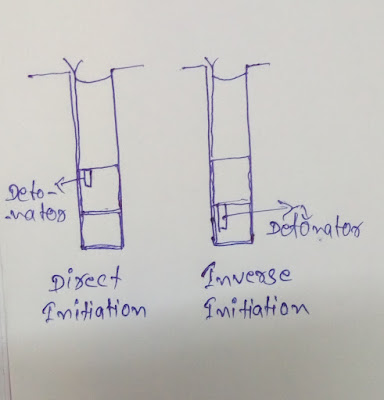
In this post we will discuss about the Charge preparation for underground blasting... For blasting, the charging of hole may consist of one or more cartridge and the separation of cartridge should be least as much possible. Among the charged explosive in a hole, it is necessary that a Detonator is inserted in one of the explosive. The cartridge having Detonator in it, called prime cartridge. To insert Detonator, a hole is maked with a Pricker of brass or wood. Insert the Detonator until it is completely buried in explosive after that put back the flap of cartridge and bind the cartridge around with wire to prevent the detonator to come out during charging. Charging of Shot Holes Proper charging of shot hole is important to get the desire results. We follows two methods to Charge the holes.. 1. Direct Initiation 2. Inverse Initiation Here we will discuss these two methods.. Preparation of Shot Hole Direct Initiation This is the method of Chargi...

Coal Dust Explosion and Prevention

Image
In previous post we have discussed about Fire damp Explosion. Now in this post we will discuss a detail about 1. Coal Dust Explosion. & 2. How to prevent it?  You May also like To Read These....       Fire Damp Explosion        Rope Splicing Let's Begin.... Coal Dust Explosion  To explode the coal dust, it has to be suspended in air as a cloud, which is capable to burst and propagate through out the mines. This propagation is due to the presence of coal dust through out the mines. As only 1g/c.c is required for propagation and it is known that no part of mines is free from that.                Before explosion the coal dust should be in the form of cloud in air and the density (30 to 40g/cubic meter) of this so much that no can see through it. To explode coal dust only sufficient density and ignition source is required. As we have discussed in previous post that the Fi...

Know everything about Fire Damp Explosion in Mines

Image
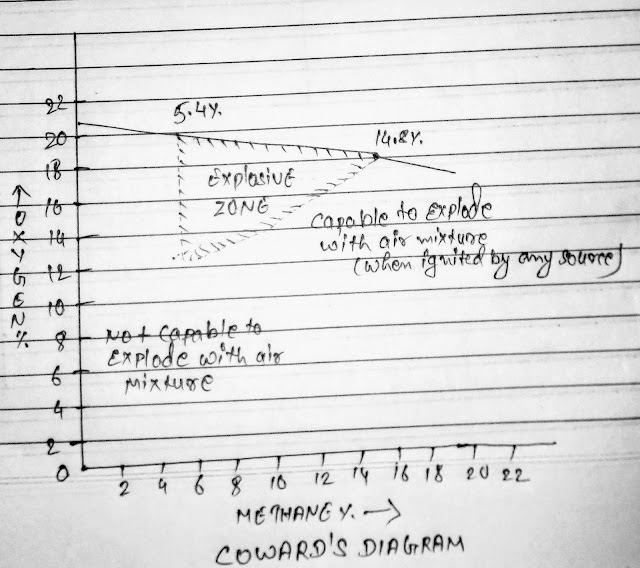
Before dealing with Fire Damp.. Here we will discuss About the Definition of Explosion and also we will know about the types of Explosion in Mines. ..So Let's Go... Q.What is Explosion? Ans...:- Explosion can be defined as it the process of sudden change in the volume of any substance instantaneously into gaseous product which produces large quantity of heat energy. Alike above explained, the explosion in mines are of three types. 1. Firedamp Explosion 2. Coal Dust Explosion 3. Water Gas Explosion In this post we will only discuss about "Fire Damp Explosion". 1. Explosion of Fire Damp(Methane) Fire damp is the most common cause of explosion in Coal Mines. The Coal Dust Explosion alone is very rare though it have been initiated by fire damp many times. The explosibility limit of firedamp is between 5.4 to 14.8% in presence of some ignition source and the percentage of Oxygen with respect to Methane percentage. "The maximum explosion...

Secondary Blasting Technique

Image
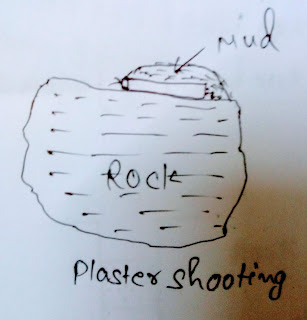
In this post we will deal about the Definition of Secondary Blasting and types of Secondary Blasting . Some other Blasting are also available you can read about that. So let's start... Definition of Secondary Blasting The technique used to blast the boulders to achieve the fragmentation is called secondary blasting. This blasting is done to get the rocks which can be easily handled. Why and how to do secondary blasting? Why secondary blasting? We does secondary, in case when the primary blasting don't give fragmentation of rock which can be easily handled. The secondary blasting is followed after the primary blasting. How to do secondary blasting? To do secondary blasting we have to follow some methods which will give us batter resultant. These are here 1. Plaster shooting or Mud Capping.. As name indicates mud capping, the primer cartridge is place at top of Boulder and covered with mud. The blasting is done from the safe place by electric detonator...

Shaft Sinking

Image
Q. What is shaft? Ans. :- It is a vertical or inclined entry made to touch seams. The word shaft is used for underground mining entrance. Q. Why shaft? Ans.:- The shaft is excavated after getting approval to mine the mineral bed by underground method of mining. Simple View of Working Shaft Shape of Shaft Generally the shaft are of circular in shape but in some mines it is of rectangular in shape. The circular shafts are best because they resist heavy side pressure and offers least rubbing surface area for ventilation. Bricking and concreting job are easy and diameter of these shaft may be varies from 4.2mts to 6.7mts. ◆The shaft sinking process is costliest and time taking process. So it is necessary to drill pilot hole within the radius of 50m of main shaft which has to be drill. This pilot hole give us an idea about the rock and how we have to encounter those problem which will we face during shaft thinking. From this we will get a data about       ...

Fires in Mines

Introduction The mines fires are classified differently depending upon their combustible material. So it is very needy to know combustible material and the extinguisher is use to extinguish the fire. The classification of fire is from class "A" to class "E". Let us know what are they and which types of extinguisher is to be used. Classifications •Class A fire: The combustible material are timber, coal, rubber, other carbonaceous materials.. Extinguisher  type: Water, sand, stone dust. •Class B fire: The combustible materials are lubricant, diesel, petrol, fuel, greases and other inflammable liquid. -Extinguisher type: Foam extinguishers are used which cuts down oxygen supply by blanketing over oil. Water is not used to quench because the  combustible materials are of oily nature, due to this they start flowing upon the and the fire will not stop. •Class C fire: The gaseous fuel are responsible for fire like LPG, CNG, etc.. -Extinguisher typ...

Detonators

Detonator:- It is a small tube of copper or aluminium having a small auxiliary charge of special explosive. Reaction in Detonator is initiated by flame or electric current. After explosion detonator provides sufficient intensity to ignite explosive. These are the types of detonator.. 1. Plain detonator:- It is also called ordinary detonator. These detonators are fired by safety fuse, spark or spit. Plain detonators are of aluminium tube having 6mm diameter and 50mm length. The is filled by A.S.A(1/3)  and P.E.T.N. A.S.A is primary composition which initiate base charge called P.E.T.N which is a powerful explosive. And 2. Ordinary electric detonator :- These detonators are fired by using electricity. In this detonator the primary charge and base charge are same as plain detonator but these are fired by the passage of current thorough fuse head. Further they are divided as:- ¡. Low tension detonator ¡¡. High tension detonator 3. Delay detonator:- These are essentially l...

Drilling Patterns

Image
Before firing a shot, it is important to drill holes and drill holes are followed by different Drilling Patterns. The selection of Drilling Patterns are different to satisfy the different conditions. So now we will know the different Drilling Patterns which are used(one by one). • Drilling Patterns are also known as shot-hole patterns. 1. Pyramid or Cone cut :-  In this type of drilling the pattern of holes something alike pyramid or cone. Pyramid cut involves the drilling of holes in centre and also at the side which meet at a point at the back. Now in modern design of cone cut involves in forming of polygon, in this also holes meet at a point with central hole. It's depth is restricted up to 60% to the width of drift. 2. Drag Cut :- It is used for smaller drift of 1.8m to 2.4m width. By making the angle so that the strata breaks along to cleavage plane. 3. Wedge Cut :- In this cut holes are drilled, whose angles are less than 45° and the centre meet along a line at...

Wire Ropes and it's construction

In mining industries wire ropes are widely used for different purposes. To perform different tasks, ropes having different qualities (strength, flexibility, galvanisation and other). Before using the wire rope in mining industries it subjected to under go many tests. They are... 1. Tensile test 2. Bending Test 3. Wrapping Test 4 Torsional Test 5. Looping Test Types of Rope according to use.. The ropes are divided in two types according to use .. 1. Standing Rope :- The ropes which is not use for running purposes.. Ex:- Guy Rope, Guide Rope etc.. 2. Running Rope :- As name indicates it is use for running purposes.. Ex.:- Winding, Haulage, Craning etc.. On the basis of construction wire ropes are divided in to two types.. 1. Stranded Ropes 2. Non-Stranded Ropes Now, below you can know a details about the both types of constructions... 1.The meaning of stranded rope is, it is made-up of strands and the strands are made-up of number of concentrically twisted wire wh...

Spontaneous Heating & Incubation Period

                Spontaneous Heating Definition:- The process of self heating of coal or other carbonaceous matter which results ignition is called Spontaneous heating. The term spontaneous heating generally used for the coal whereas it is rare to the other materials. Process of Self Heating The exposed coal to air starts absorbing oxygen and the chemical reaction starts which leads to the evolution of CO ,  CO 2,   water vapour and heat. The process is very slow and the heat is not perceptible. This slow process slightly rise up due to rise in temperature and due to this the other part of coal become ready for oxidation. This slower process reaches a stage where temperature reaches the ignition point and the coal catches fire. *It is necessary to take air sample constantly of return air, if any increase in CO percentage is detected then there is need of investigation.                ...

Some Important Terms

Adit :- It is a type of nearly level roadway, driven to access a deposit which is at the higher level than the ground surface. Overburden :- The valueless rock body covering the mineral up to the ground surface is called Overburden. Chute :-It is a narrow passes from which the broken ore is loaded in Mines cars. Country Rock :- The rock which contains the ore body, the hanging wall and the foot wall forms from the country Rock. Hanging wall :- It is the roof of bedded deposit. Foot wall :- It is the floor of bedded deposit. Exploration :- The searching of mineral and gaining the knowledge of shape, size, position, and value of an ore body. Heading :- The driving of roadway in any part of U/G mines, mainly in development stage. Level :- A approach to the mineral bed by driving a horizontal roadway by branching the shaft, called level. Shaft :- It is a inclined or vertical entrance to mined out the economical deposit.